For Konstantine Rountos, Ph.D., the St. Joseph’s University, New York motto — Esse non videri, “To be, not to seem” — isn’t just an institutional touchstone. It’s a personal philosophy.
“They are biologists. They are published biologists,” he said of the undergraduate students who have co-authored peer-reviewed papers under his mentorship. “They’re not just seeming to be biologists. Their projects actually contribute to global scientific knowledge.”
The distinction matters immensely to Dr. Rountos, who has spent the past decade at the Long Island Campus helping shape the next generation of environmental scientists. This, while also conducting his own research, heading the sustainability committee, co-chairing the institution’s Middle States reaccreditation effort, and, in those hours that remain, hiking, tending a pollinator garden, and crafting cheese from kefir cultures.
How does he fit it all in? Short answer: he just does.
For instance, when Middle States site visitors came to campus, Dr. Rountos recorded lectures rather than cancel class and kept students informed every step of the way.
“Never leave the students not knowing what to expect,” he said. “In academia, you learn how to thrive in a high-stress environment.”
The longer answer involves a genuine passion for his work.
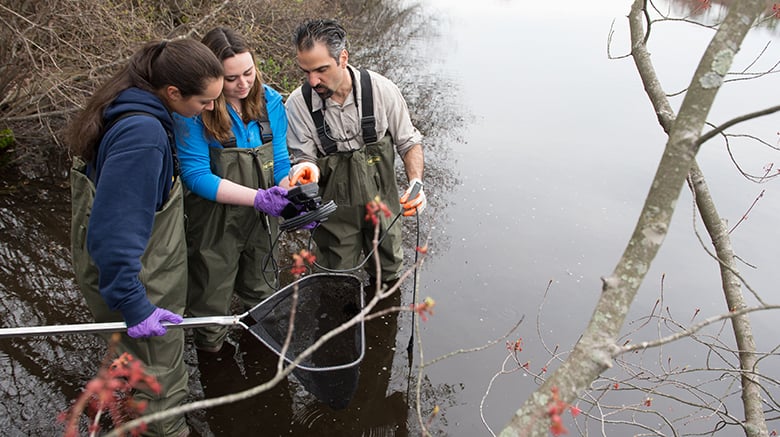
Since joining SJNY’s biology faculty in 2016, Dr. Rountos, who earned his Ph.D. at Stony Brook University, has built a research program that runs seamlessly into the undergraduate experience.
Three peer-reviewed journal articles have emerged from student thesis projects he oversaw. A fourth is in review. More are in the pipeline.
A 2023 study published in “Marine Pollution Bulletin” was the first in New York to examine microplastics in oysters and hard clams sold at fish markets. The research with students Isabella Colombo and Mackenzie Minder earned him a call from The New York Times; he was quoted extensively in an article titled, “Are Shellfish Good for You?”
“This wasn’t Stony Brook, it wasn’t Cornell, it wasn’t NYU, it wasn’t Columbia — it was St. Joe’s,” he beamed.
A 2025 study with student Afifah Khan found that non-selective suspension feeders — organisms that cannot filter what they ingest — carry significantly higher microplastic loads than selective feeders, such as oysters. The implication: Organisms researchers typically use as environmental indicators may give a systematic underestimate of microplastic contamination in our waterways.
Beyond the lab, Dr. Rountos heads SJNY’s sustainability committee, overseeing student environmental clubs, native pollinator garden installations, lake cleanups and numerous academic events.
He also designed BIO 210: Science Without Borders. The study abroad course brings students to Greece, weaving hiking, snorkeling and river surveys with cultural immersion.
Influenced by his own Fulbright Fellowship conducting research at the University of Crete in Greece, the class’ fifth trip is in June.
Then came Middle States. Over the past two years, Dr. Rountos and colleague Kestrel Perez, Ph.D., co-chaired SJNY’s self-study steering committee, leading an institution-wide process necessary for reaccreditation.
Weekly steering meetings, office hours for working group members, open sessions at University-wide meeting days, and coordinating faculty, staff and administrators at both campuses. He took it all on, alongside a full teaching load and ongoing research.
This spring, Dr. Rountos received a promotion to full professor, effective this September.
