Kestrel Perez, Ph.D., grew up in Watermill, spending her childhood close to the water. As long as she can remember, she knew she wanted to study the ocean. What she didn’t know until later was which part.
“I was interested in whales,” she said. “And then I became more interested in studying very small animals that are really at the bottom of the food chain.”
The pivot from the ocean’s most spectacular creatures to its most essential ones is central to everything Dr. Perez does.
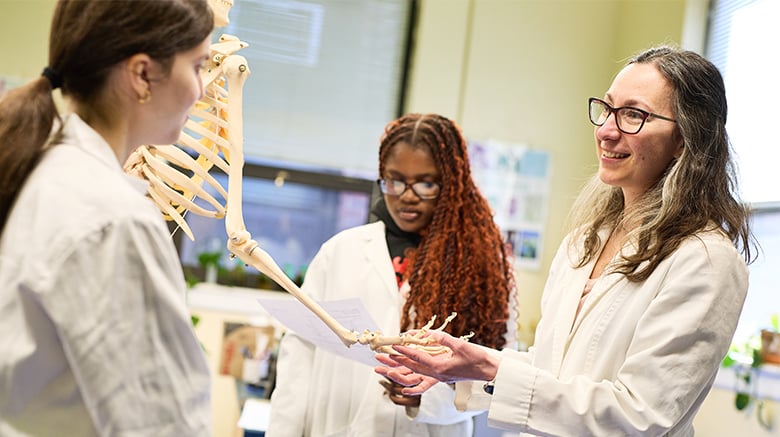
A professor of biology at St. Joseph’s University, New York’s Brooklyn Campus, her research focuses on how environmental stressors affect the earliest life stages of marine fish: the larvae, the juveniles, the small forage species that invisibly hold the entire marine food web together.
“If we can really figure out what’s causing these little food fish problems,” she said, “then we can have a better understanding of what’s impacting larger fish.”
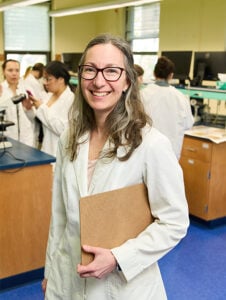
Professor of Biology Kestrel Perez, Ph.D.
Dr. Perez earned her B.S. from Southampton College, where she was part of the last graduating class before Long Island University closed the campus. She received her Ph.D. from Stony Brook University, where she overlapped with a fellow Ph.D. student who would later become a close colleague: Konstantine Rountos, now a biology professor at the University’s Long Island Campus.
Following Stony Brook, she completed postdoc education at the University of Texas’s marine research station in South Texas before finding her way back to New York.
“I really loved the education I received at Southampton,” Dr. Perez said of what drew her to St. Joseph’s. “Undergraduate focused, small class sizes. I just wanted to get a job at a school like that.”
She has now taught at St. Joseph’s for just over a decade. In that time, she and Dr. Rountos collaborated on a multi-year NOAA-funded study examining how harmful algal species and ocean acidification affect local fish populations.
It was conducted at Stony Brook’s Southampton research station with St. Joseph’s undergraduates working alongside graduate students on-site. Manuscripts for publication from the research are now in progress.
Dr. Perez also co-authored a chapter in a textbook on One Health and the aquatic environment, and was co-author on a recent perspectives piece in Fisheries, the flagship journal of the American Fisheries Society.
Her Conservation Biology elective perhaps best captures her approach to teaching.
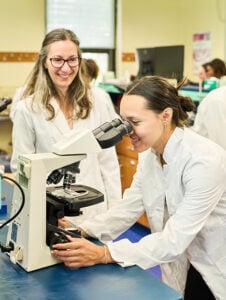
In addition to her teaching responsibilities, Dr. Perez served as co-chair of the middle states reaccreditation committee.
The upper-level course runs simultaneously on both campuses — Dr. Perez teaches in Brooklyn one day, travels to Patchogue another, with each section zooming into the other’s classroom in real time. By semester’s end, students who have never shared a physical space feel like classmates.
“There’s so much engagement,” she said. “The students really learn from each other.”
That kind of cross-campus spirit extended to the Middle States reaccreditation process, which Dr. Perez co-chaired alongside Dr. Rountos over the past two-plus years. More than 70 faculty, staff and administrators contributed across seven working groups.
“It was very much a team effort,” Dr. Perez said. “I was just one piece of the puzzle.”
It’s a characteristically modest framing from someone who stepped into, as she put it, “pretty big footsteps”, by following the example set by Dr. Heather Barry and Dr. Karen Russo, who had previously served as co-chairs of the last Middle States reaccreditation process. She and Dr. Rountos have both been promoted to full professor, effective this September.
SJNY’s motto — Esse non videri, “To be, not to seem” — resonates personally, she said, especially through undergraduate research. She takes great pride in watching students move from uncertainty to ownership, growing to be genuinely excited about what they’re discovering.
“Never expect your experiment to work the first time,” she tells them. “Don’t get discouraged if it fails. That’s a normal part of the process.”
