For the summer of 2025, 10 students were selected for the Summer Undergraduate Research Fellowships (SURF), an SJNY-funded undergraduate research program that provides stipends of $4,000 for each student recipient to work on research projects, overseen by a faculty mentor.
With an overarching goal of alleviating the economic pressures that can prohibit strong students from actively engaging in academic research opportunities, the SURF program is open to students of all disciplines. Recipients conduct their research for 10 weeks over the summer and then present at the Student Research Symposium the following spring.
Exploring Ocean Acidification and Fish Behavior
Brooklyn student Milana Haripersaud was one of this year’s SURF participants, conducting research on the effects of ocean acidification and harmful algal blooms on young Sheepshead minnow fish.
“Ocean acidification is an urgent issue that couples to global warming,” Haripersaud explained. “As humans increase carbon dioxide production, much of it ends up absorbed by the ocean. Dissolved carbon dioxide lowers the pH of the ocean and these drastic changes can shock marine life and fuel other problems, like harmful algal blooms. My research studies how these conditions affect food consumption in Sheepshead minnows and how re-exposure can further impact their survival.”
Her interest in the project first emerged in Dr. Perez’s ecology course, where she presented on the effects of ocean acidification on coral reefs. “After seeing my interest, Dr. Perez welcomed me into her research group,” she said. “I was especially inspired by a past student’s thesis on artemia and fish feeding.” She took his work further by testing the fish directly.
Why the Research Matters
Haripersaud’s project connects to pressing real-world concerns. “The rapid increase of carbon dioxide has caused oceanic pH to drop by 0.1 units in the last 100 years. By the year 2100, it may fall to 7.7, which could cause the extinction of many marine species,” she explained.
Understanding these impacts on feeding behavior can help predict fish health and survival under future conditions.
Life in the Lab
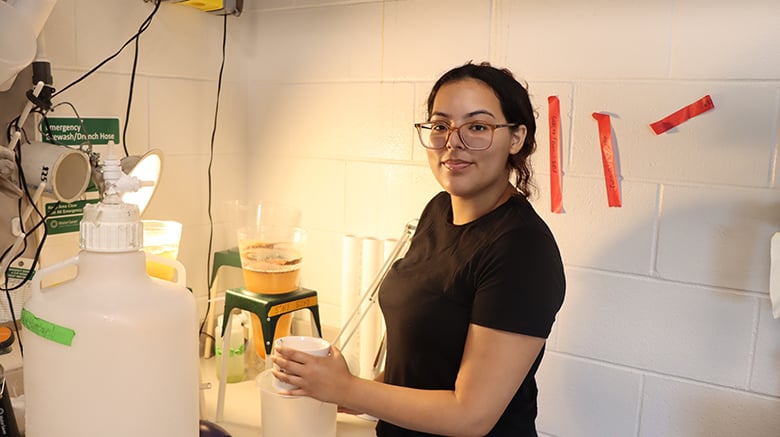
Based at the Stony Brook Southampton campus, her days began early in the wet lab.
“At 9 a.m., I’d uncover the fish tanks, record pH and dissolved oxygen levels and feed the minnows live artemia that we raised ourselves,” she said.
From there, she’d spend the afternoon counting algae, exposing fish to harmful blooms and timing how quickly they consumed food.
Even long days had their highlights. “Around noon, I’d grab a strawberry lime smoothie from Tropical Smoothie Cafe before heading back to the lab. After finishing in the evening, I’d enter data into Excel and relax with a TV show, usually a zombie series, reality TV like Love Island, or a Korean show.
Mentorship and Growth
Haripersaud worked under the mentorship of Dr. Kestrel Perez, who has guided her through both coursework and independent research.
“Dr. Perez has been absolutely wonderful,” Haripersaud said. “She taught me that research is always changing. Projects evolve and you need to adapt to obstacles along the way.”
Being part of the SURF program has meant more than just research. It gave her the chance to explore career paths to see what fits her best.
“It also allowed me to study a global issue while earning money for the semester, which helped me focus on my academics,” she continued.
Looking Ahead
Haripersaud is preparing for the next steps in her academic journey. Currently applying to pharmacy schools, Haripersaud is also considering graduate programs in marine biology or pharmacy research.
Her summer fellowship not only gave her hands-on training in the lab, but also the chance to explore her academic passions, which might connect to her long-term career.
This story is part of OnCampus’ “SURF Recipients 2025” series, centered on students conducting research at St. Joseph’s University, New York in anticipation of the University’s 2026 Student Research Symposium. To read more from this series, click here.
