
In the summer of 2026, St. Joseph’s University, New York’s Summer Research Fellowships (SURF) program officially turned five years old. The 100% donor-funded program offers $4,000 stipends to a select number of students each year to work on research projects of their choosing.
SURF was established to encourage students to engage in academic research opportunities while alleviating the financial pressures of doing so. Every year, 10 students are selected across a range of disciplines — conducting research over 10 weeks which they will then present at the Student Research Symposium the following spring.
Investigating Color Blindness and Smartphone Use
For 2026 SURF recipient Suraj Chaudhary ’28, a mathematics and computer science major on SJNY’s Brooklyn Campus, a familiar accessibility issue raised an unfamiliar question: How does color blindness affect the way people use their smartphones?
“Many smartphone interfaces rely on color to attract attention,” said Chaudhary, “from red notification badges and green icons to brightly colored buttons. If you can’t see those colors the way most people do, does your phone feel less addictive? Or does the frustration of navigating interfaces designed around typical color vision actually make you use your phone more compulsively?”
Searching for the Right Research Questions

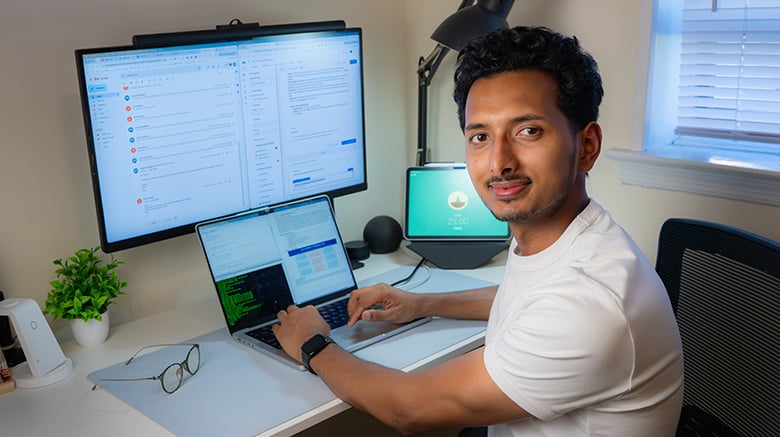
Suraj Chaudhary’s research delved into the correlation between cell phone accessibility and color blindness.
Chaudhary said the idea for the project grew out of a conversation he had with his faculty adviser, Anna Pennisi, Ph.D., during his first semester at St. Joseph’s. Their discussion began with the broader issue of making science more accessible, including the barriers created when research is primarily published in English. Eventually, the conversation turned to accessibility in technology.
“How does color blindness affect someone’s experience of using a smartphone? Could it make things harder and actually drive more compulsive use? Or could it work the other way, as a kind of natural buffer against the reward signals apps are designed to trigger?” Chaudhary said. “We didn’t have an answer for that question yet. So we decided to go find one.”
Finding Answers When Research Doesn’t Follow a Straight Line
Chaudhary’s work sits at the intersection of psychology, computer science and design. Much of his time has gone into developing the project’s survey, ensuring that its color-vision screening works correctly and evaluating whether each question contributes meaningfully to the study. Other days involve reading research papers to test the methodology or writing code to generate stimulus images used in the screening.
He has also learned that research rarely follows a straight path. At several points, Chaudhary realized that an approach he had been pursuing was not the right one and needed to be reconsidered.
“Every time it’s happened, the version I built after starting over was meaningfully better than what I would have had if I’d pushed through with the original approach,” he said. “I’ve started to see those moments less as setbacks and more as the research doing its job, telling me something true that I needed to hear.”
Throughout the project, Chaudhary has worked closely with Dr. Pennisi. He particularly values her ability to clarify complex ideas and precisely articulate concepts that can initially be difficult to put into words. “Working with her has made me a clearer thinker, partly because she models what clarity actually looks like,” Chaudhary said.
Appreciating an Opportunity to Explore
For Chaudhary, participating in SURF has provided the time and resources to move beyond simply wondering about a research question and begin testing it. As an international student, he said the opportunity to conduct original undergraduate research is something he does not take for granted.
“The SURF program gave me the space and the resources to take an idea seriously, to actually test it rather than just wonder about it,” Chaudhary said. “I also hope it shows other students, especially those who don’t come from traditional research backgrounds, that this kind of work is something they can do, too.”
This story is part of OnCampus’ “SURF Recipients 2026” series, centered on students conducting research at St. Joseph’s University, New York in anticipation of the University’s 2027 Student Research Symposium. To read more from this series, click here.
