
This fall, St. Joseph’s University, New York will welcome a new class of first-year students, who will undoubtedly arrive with many questions on their minds: What major should I choose? Will I like living in a residence hall? Will I be able to adjust to living with a roommate? When classes start, will I be able to stay organized and keep up with my classes? Will I be successful?
Such questions can be nerve-wracking for any student, but they can be overwhelming for new students, in particular.
That’s why, in July, SJNY’s Brooklyn and Long Island campuses held half-day pre-orientation sessions, called DiscoverU. The programs were designed to help students understand what to expect this fall, to give new students a way to better navigate around the school and to get a sense of what resources would be available to them.
“We really hope the incoming students leave these sessions,” said David Gonzalez, assistant vice president for student life, “feeling more confident and better prepared about everything” from financial aid issues to figuring out classes and class schedules to simply living in a new environment. But after these sessions, Gonzalez hopes that “each student will have a better idea of what he or she will be doing the first couple weeks on campus. That’s exactly what we’re going to help address today.”
The First-Year Experience: Helping Students Anticipate and Navigate Change
While the goal for the DiscoverU team was undoubtedly to provide students with as much information as possible about all the resources that are available to new students, Gonzalez and Student Life also noted that almost all students will experience moments of uncertainty and doubt, as well as many questions and concerns. But in many ways, such uncertainty is normal.
For example, Executive Dean Phillip Dehne, Ph.D. pointed out that it’s not uncommon for a student to actually have doubts about the major he or she has selected. In fact, Dehne pointed out that roughly one-quarter to one-third of SJNY students change their major during their first or second year. But he emphasized that this data point shouldn’t be surprising when you consider that these years are a time when students should explore all their interests rather than feel committed or locked into a major they choose on the first day of classes.
If students discover another path that’s a better fit, it’s perfectly normal to change majors—and the University has people ready to help you make that transition. “We help students change majors all the time,” Dehne said. “I think one of the great aspects of being in higher education in America. And we’re really out here to help you.”
Tapping the Source: Practical Advice from SJNY Students
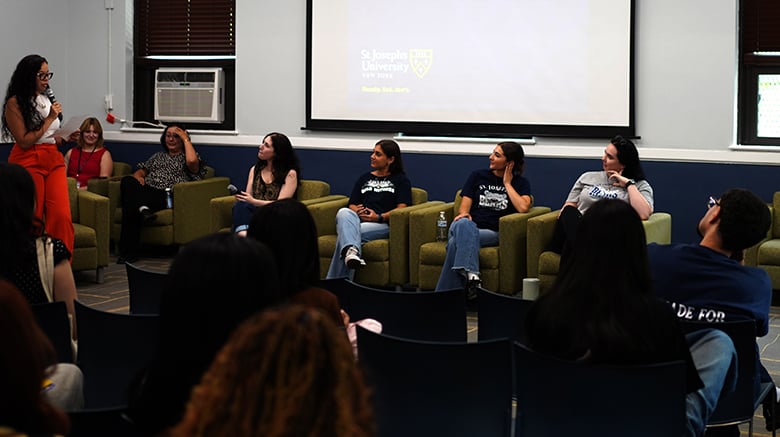
During the three-hour program, incoming students attended several different sessions that gave them insightful information on the University’s resources and what to expect in the fall. However, although these sessions were very helpful and enlightening, perhaps the liveliest session was the Q&A panel titled “Student Panel: The SJNY Experience – Leadership Through Engagement,” which was also the last session of the day.
What made this session so valuable was that the questions from the audience were answered with very practical and perceptive advice from four upperclassmen (three seniors and one junior) currently attending SJNY: Sophia Longo, Olivia Lieto, Anna Makarouna and Reanna Noon.
Here are some of the useful takeaways these student leaders provided for the incoming class:
1. Don’t Stress—Everyone is New at Some Point
Your first week may feel overwhelming, but faculty and staff know you’re adjusting. So, the students on the panel suggested that you should try to relax. “If I could do my freshman year over again, I would tell myself that I should try not to worry too much,” said English major Sophia Longo. “Everyone knows you’re a freshman and it’s your first semester. Don’t stress. Just try to take a moment and look around. And ask questions!”
Olivia Lieto, a Biology major with a minor in Chemistry, had similar advice, noting that if she could redo her first year, she’d tell herself, “The first week is going to feel like you have no idea what you’re doing. I would tell myself that I’ll make friends, and I’ll be comfortable in school.”
2. Get Involved on Campus…as Early and as Often as Possible
But in order to get acclimated and feel comfortable more quickly, Lieto suggested that if she was a freshman again, she “would tell myself to get involved on campus.” Join clubs, attend events, consider work-study, and participate in campus activities. Student leaders said this was the best way to make friends, feel comfortable and become part of the SJNY community. First-year students should, “definitely get involved,” she said.
Psychology major Anna Makarouna echoed that advice, “My first semester at St. Joe’s, I didn’t get involved in anything on campus. Even when club events were happening, and I would see them happening, I just wouldn’t go because I wasn’t familiar with them. But I honestly wish I did because getting involved in anything on campus is how you’re able to become comfortable. You’ll also meet people outside of your major.” Makarouna suggested that if a first-year student sees “an event happening, don’t be afraid to walk in and ask what the event is. Because 99 percent of the time, the students will gladly tell you what it is and encourage you to stay and be part of the event!”
3. Read Every Course Syllabus Carefully
The entire panel agreed that this might be one of their most important tips. “Read the syllabus. Always,” Lieto emphasized. She also noted that for every class, every professor is required to post one at the beginning of the course. “It will lay out every single date for every lesson.” It will also indicate when exams, projects and other class assignments are due. So, when it comes to your classes, if you can keep track of the syllabus, “you’ll be set,” said Lieto.
4. Build Relationships with Your Professors
Because class sizes are small at St. Joe’s, professors quickly get to know students. So, introduce yourself, ask questions, and seek feedback on your assignments. Reanna Noon, who’s a Criminal Justice major with minors in Legal Studies and Psychology, says “Although we all know it’s very scary to start, try and put yourself out there as best you can. Get to know your professors.” Since she says it’s such a small school, with an average 12-to-1 student-teacher ratio, “the biggest class you might have is one with 35 students.” The University’s small size also allows professors and staff to get to know students’ names and faces within the first couple weeks. The result, Noon says, is often a great rapport.
5. Take Advantage of Every Campus Resource
When it comes to University resources, students should take a seize the day approach: During orientation, for example, visit as many information tables as you can. Or when classes begin, meet with IT to learn more about what’s available to help you.
There are also several University centers and offices, which the students on the panel recommended incoming students visit and get to know.
“The Office of Financial Aid is open every weekday until 5 p.m.,” Makarouna said, “Don’t be scared to reach out to those people,” since they oversee a number of important resources. “For instance, there are scholarships that go out in the beginning of every school year that are open to everyone that you can apply for.” She recommended getting to know the people at the financial aid office (as well as other offices) so that “they can get to know you and your situation better and help you as much as they can. That’s what they’re there for.”
For Longo, although the financial aid office was the first department she interacted with at St. Joe’s, she said she also received a lot of help from The Center for Counseling and Wellness, which allowed her “to speak to somebody and get advice. That was really helpful for me. It was a great resource.”
Additionally, Noon highly recommended students visit the University’s Academic Center, which is open to any student on campus. “They’re not only helpful with any academic accommodations you might need,” she said, “but they also have writing tutors, which can be really helpful, especially if you get an assignment, say, to write a paper in a format you’ve never used before. They do everything from brainstorm ideas with you for a paper to reading your final draft. So, I’d definitely recommend utilizing that service.”
