
A University by the Bay
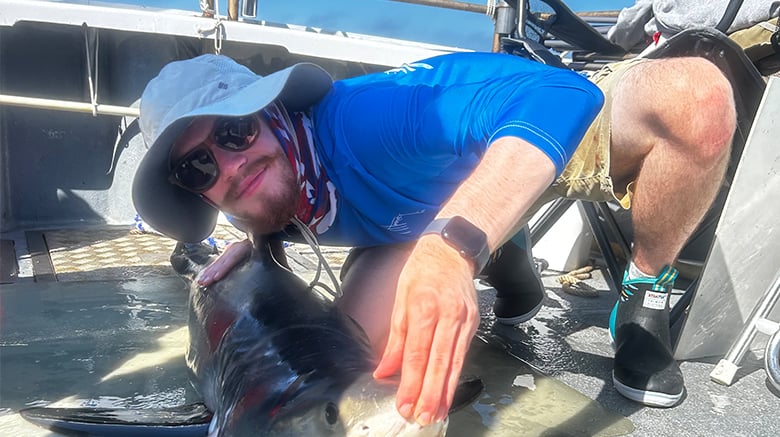
For St. Joseph’s University, New York Alumnus Joseph Candia, living on Long Island afforded him a life of exploration. From childhood fishing trips in the Atlantic Ocean and days spent at the beach, to visits to the Long Island Aquarium in Riverhead, the now 24-year-old graduate student reflects on the elusive nature of the marine life just outside his door. Who would have thought that a childhood fascination would one day become a career in marine biology?
Even if Candia did not know it at the time — enrolling at St. Joseph’s University as a biology adolescence education major — the path he now follows was set on his first day on the Patchogue Campus. One thing he observes now as a graduate student at the University of Rhode Island (URI) is the advantage St. Joseph’s offered him in terms of applying practical research to his undergraduate studies, a stark contrast to the experiences of some of his classmates.
Noted for its teaching and biology programs, the lakeside University also resides less than three miles from the Great South Bay with access to a lab in Southampton, making it the ideal institution for someone with an interest in marine biology.
According to Candia, St. Joseph’s provided a foundation for mentorship, collaboration and networking — three factors that have driven him to dive deeper into research as he currently studies the movement and ecological behaviors of whale sharks and blue whales in his third and final year of graduate school.
“There was so much time for us to explore at St. Joseph’s. We always had a lab with all of our bio classes, so we were always doing something hands on … I got more experiences than money can buy,” Candia shared.
From Student to Teacher to Co-author
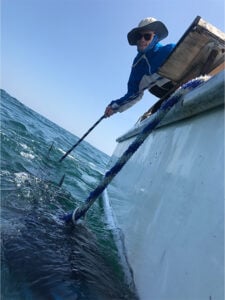
Candia currently studies the movement and ecological behaviors of whale sharks and blue whales.
Initially on track to become a biology teacher, experiences such as presenting at SJNY’s research symposium, working as a teaching assistant under Biology Professor Konstantine Rountos, Ph.D., and as a lab assistant widened Candia’s gaze to the possibility of becoming a marine biologist. In fact, it was Dr. Rountos who inspired Candia to want to pursue a career in research, taking him on as a mentee.
“Joe is one of the most intelligent and hardworking students that I have had the pleasure to teach at SJNY. He is passionate about research, and I am sure will continue to thrive in his graduate career in marine science. I am so proud of him,” Dr. Rountos shared.
Most recently the two co-authored a study published in the Marine Pollution Bulletin and the Journal of Plankton Research evaluating the combined effects of ocean acidification and harmful algal blooms on the fitness of brine shrimp. Aside from being a tremendous achievement for a researcher his age, the collaborative effort between former student and professor speaks volumes to the relationships forged at St. Joseph’s University and their persistence even post-graduation.
It was with the guidance of Dr. Rountos that Candia chose to pursue a master’s degree in biological and environmental sciences and expand the scope of his research into something that interested him personally. Helping him stand out were both his experiences in research and teaching.
“My entire curriculum at St. Joe’s rounded out my ability to understand biological theory and how to teach it. Together, it was this perfect mixture. I was doing field work from my sophomore fall semester,” Candia said.
Two Homes on One Long Island
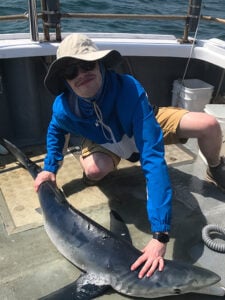
Now in his final year of graduate school, Candia plans to pursue his Ph.D.
The decisions made and skills garnered during his time at St. Joseph’s continue to dictate his successes today, with Candia winning an award in his position as a teaching assistant at URI.
With so much already accomplished, one might ask what’s next for Candia?
His sights are now set on obtaining his Ph.D., and Candia is exploring the idea of moving to Florida to collaborate with other marine biologists in the area who are conducting various types of research.
“I am so much more connected to this field than I ever thought I would be,” he shared. “I’ve been attending the American Elasmobranch Society Conference for the last two years and just presented this year. Meeting professors and scientists in the field, as well as graduate and undergraduate students has only helped to expand my network even more.”
As Candia nears completion of his master’s thesis, he has already begun to think about the type of research he’d like to conduct as a Ph.D. candidate, striking a balance between work in the field, the lab and on the computer. And although it’s not set in stone, he finds comfort in knowing that St. Joseph’s and all the connections he made along the way are still there for him.
“I come home for holidays and stop by St. Joe’s on the way,” he shared. “The entire biology department was so supportive and really made me see that I could not only become a scientist but become a successful one at that. This is something I’ve wanted to do since I was a kid, and I see myself staying in this field and going forward thanks to my time at St. Joseph’s.”
