
More than a History Lesson
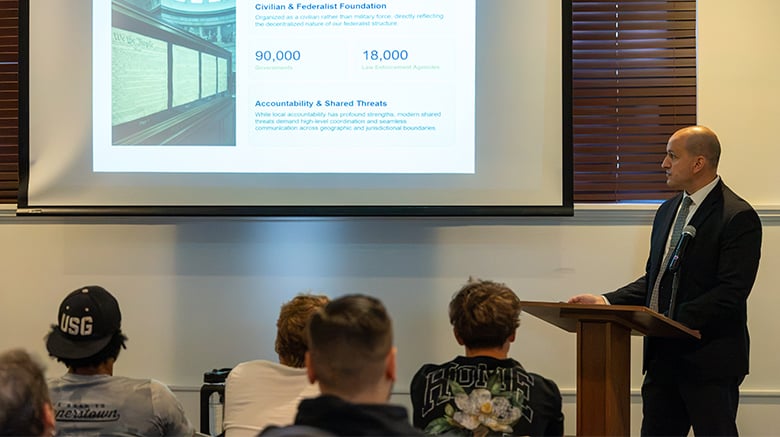
Twenty-five years after the events of September 11, 2001, the effects of that day continue to shape American public safety and criminal justice. On Sept. 16, students and professors gathered in the Shea Conference Center to hear Assistant Professor of Criminal Justice Jason Ostrowe, Ph.D., examine the environment surrounding September 11, 2001 and the response that followed.
With more than 25 years of experience as a criminal justice practitioner, analyst and educator, Dr. Ostrowe brings a unique perspective to the discussion. He served with the New York City Police Department from 1999 to 2015 and was working in Manhattan on the day of the September 11 attacks. Since 2022, he has served as a faculty member of SJNY’s Criminal Justice Department.
During his presentation, Dr. Ostrowe discussed the public safety environment and political violence that were already a part of American life before September 11. He also explained the ways the attack changed public safety, criminal justice and American society in the years that followed, saying “One cannot understand public safety and criminal justice in 21st-century America without understanding the history that changed it.”
The Past is Prologue
Dr. Ostrowe first examined the development of the nation’s public safety system explaining, “The public safety apparatus in this country developed over time through political control, reform and increasing professionalism.” He also discussed the changing role of law enforcement and the pressure placed on police departments as crime and violence increased throughout the 1960s, 1970s and 1980s.
“Political violence also has a much longer history in the United States than September 11,” Dr. Ostrowe stated, placing September 11 within the broader history of violence in the United States.
He discussed political violence and terrorism that occurred decades before the attacks, including the 1993 World Trade Center bombing and the 1995 Oklahoma City bombing. While the two attacks differed in perpetrators and motivations, Dr. Ostrowe used them to demonstrate how Americans understood and responded to threats before September 11.
Dr. Ostrowe also cautioned against viewing these events solely through the lens of hindsight, stating “Those of us in the social sciences will recognize how recency bias and availability heuristic can shape our expectations. In other words, recent events and those we can remember most vividly dominate our sense of what might happen next.”
A Deeper Perspective
Dr. Ostrowe then introduced a short documentary film titled “Twin Towers,” directed by Bill Guttentag and Robert David Port. The film captures the reality of the September 11 attacks following Joseph Vigiano, an NYPD officer, and his colleagues as they navigate their work and family lives before the events of September 11. The film gives us a personal look at the lasting impact of the attacks on the Vigiano family and those who served alongside Joseph.
Following the film, Dr. Ostrowe returned to the changing responsibilities of law enforcement after the events of September 11.
“The police still had to answer calls, investigate crimes and handle everyday emergencies. Now they also faced greater, expanded expectations around counterterrorism and protecting potential targets,” he said.
Lasting Effects
Dr. Ostrowe also addressed the continuing effects of September 11 on those who were directly exposed to the attacks. He discussed the World Trade Center Health Program and health conditions suffered by survivors, such as respiratory illnesses, cancers and mental health conditions.
“Concerning uterine cancer, I’m very proud to say that I played a role in securing coverage for that while serving on the World Trade Center Health Program Scientific Technical Advisory Committee,” he said, emphasizing that the consequences of 9/11 extend far beyond that day itself.
Dr. Ostrowe concluded by returning to the people at the center of history, including Joseph Vigiano and his family. He emphasizes that for students who were not alive on September 11, 2001, understanding the event requires learning about and listening to the experiences of those who lived through it.
“Understanding September 11 involves understanding the world that came before it, the people who lived through it, and the responsibilities that remain ours today,” Dr. Ostrowe concluded.
