
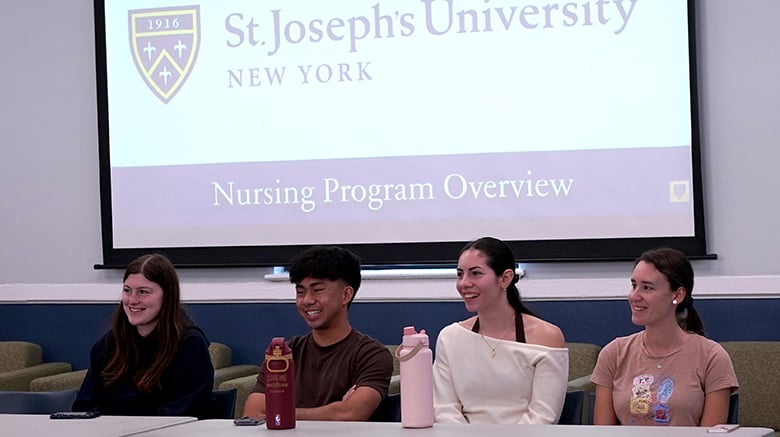
What does it take to succeed in nursing school? For first-year nursing students at St. Joseph’s University, New York (SJNY), the best advice may come from those who have already experienced the challenges of earning a nursing degree.
On Wednesday, Oct. 14, a group of junior and senior nursing students gathered in the Tuohy Hall Lounge on the Brooklyn Campus for the Freshmen Nursing School Survival Guide Panel, an event designed to help incoming nursing students navigate their academic journeys.
The panel, which included members of SJNY’s Bachelor of Science in Nursing (BSN) Club, offered practical advice on everything from developing effective study habits and managing time to overcoming academic setbacks and making friends. Leila Husien, a senior nursing student who serves as president of the nursing club and helped lead the discussion, explained that the panel was inspired by her own experiences. “I’m a senior right now, so, for me, I’m at that point where I’m reflecting on my journey in nursing school, but I’m also really excited to graduate,” she said.
Finding the Right Study Strategies
One recurring theme was the importance of discovering which study methods work best for each student, particularly when tackling demanding courses such as anatomy and physiology, microbiology and psychology.
One senior panelist recalled struggling during her first semester because she had not yet learned how to study effectively. “My best advice is to learn how you learn. In other words, learn how your brain retains information and do what works for you,” she said.
Other students recommended forming study groups, taking practice exams, using flashcards and exploring online resources, including YouTube and AI tools such as ChatGPT, to reinforce difficult concepts. Another panelist stressed that understanding the material was more important than simply memorizing it. “You don’t really know if you actually understand it until you do practice questions,” she explained.
Balancing Academics and Personal Life
Panelists also discussed the challenges of balancing demanding coursework with part-time jobs, family responsibilities, friendships and hobbies. One student emphasized the importance of organization. “I’d say the number one thing, absolutely the number one thing, is to have a calendar or have a planner,” the student said. “Have some type of structure when you’re in school.”
Several panelists shared how they adjusted their work schedules to accommodate exams and clinical responsibilities. Others encouraged students to make time for exercise, relaxation and social activities. The students also spoke candidly about academic setbacks, emphasizing that disappointing exam grades can become opportunities to improve study habits and develop greater confidence.
Building Friendships and Finding Support
Beyond academics, the panel highlighted the importance of building relationships with classmates, professors and mentors. One panelist encouraged first-year students to connect with those further along in the program.
“I would say try to be friends with somebody who’s maybe a year or two older than you,” she said, explaining that advice from senior students had helped reduce her own anxiety.
Another student encouraged first-years to take advantage of the University’s resources, including tutoring and counseling services, while getting to know their professors.
Following the panel discussion, first-year students had an opportunity to ask questions about study techniques, laboratory practical exams and other concerns.
The event concluded with an invitation for first-year students to continue reaching out to upperclassmen for guidance, reinforcing the importance of mentorship and community throughout their nursing education.
