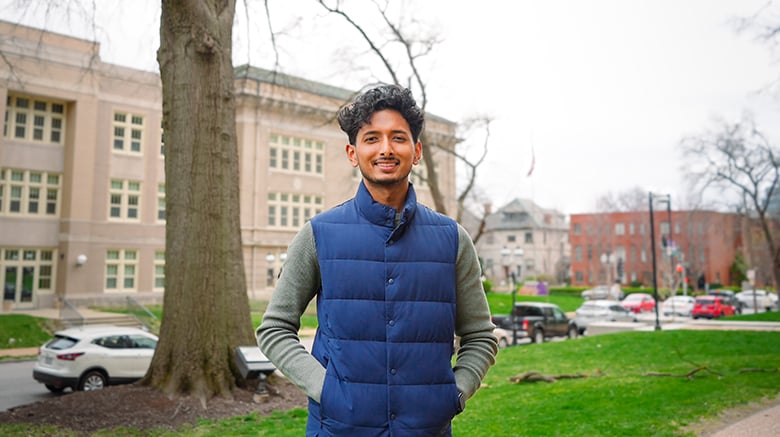
While many students were enjoying their spring break at home, Suraj Chaudhary ’28 was in St. Louis on a service and mission trip with Campus Ministry, awaiting exciting news. During the trip, the Brooklyn campus honors’ student and mathematics and computer science major spent his days exploring the city and its rich history. Meanwhile, his nights were dedicated to coding for the global Morgan Stanley “Code to Give” Hackathon.
It was on March 16 that he learned from his teammates in New York that they had won first place in the competition.
For many, a competition of this magnitude would be overwhelming. Chaudhary himself described it as “exhausting but incredibly rewarding”. The opportunity, however, was too exciting to pass up.
About the Hackathon
The “Code to Give” hackathon is a prestigious one. Chaudhary and his teammates were among 120 students chosen to participate from around 2,000 applicants worldwide, including students from various Ivy League universities.
“We actually didn’t know the project details beforehand,” said Chaudhary. “We applied knowing only the mission: Code to Give. We were motivated by the idea of using our skills for social good.”
Once selected, participants were put into groups and assigned to a project.
Chaudhary’s Project
Chaudhary and his teammates, all college students in the New York/New Jersey metropolitan area, were assigned to code for LemonTree, a New York based non-profit organization that helps those experiencing food insecurity.
The project was on Track B of the hackathon, centering on Data Intelligence and AI. The main focus was to create a code that could organize LemonTree’s data, enabling the organization to better serve those they assist.
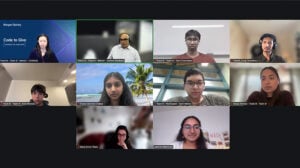
Chaudhary and his team worked on their project via Zoom.
From there, Chaudhary and his teammates had five days to code. His role was integral from the early stages, taking the initiative to create a to-do list so that all eight participants could work on coding without the constant need for real time communication. Of course, Zoom calls would be part of the process, but the list helped organized the group. Chaudhary called it their “North Star”.
He pointed out three major elements of the final code that he believes made it stand out enough to win first place for their track: the creation of a custom interface for each of the various roles in the organization that need to access the code, the use of Large Language Models to analyze open-ended feedback, and the integration of census data into the pre-existing software so that gaps between need and availability of LemonTree’s services were easier to bridge.
The Significance of SJNY
Chaudhary credits his professors at St. Joseph’s for enabling his success in the hackathon. Specifically, he cites the mentorship of Elizabeth Zollinger, Ph.D, the associate chair of the Mathematics and Computer Science Department, as well as Professors Asher Roberts, Ph.D and Eleni Zamagias.
Chaudhary takes immense pride in representing his school on such a prestigious stage. The hackathon, he says, proved that in terms of both technological innovation and social responsibility that “the foundation we’re building at St. Joseph’s can compete with the best in the world.”
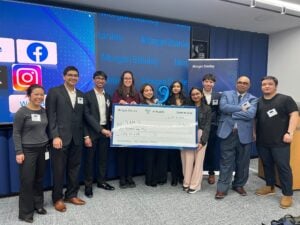
Although he was unable to accept his award in person, Chaudhary is incredibly proud of his team and their accomplishment.
