Transformational Change and a Call to Action
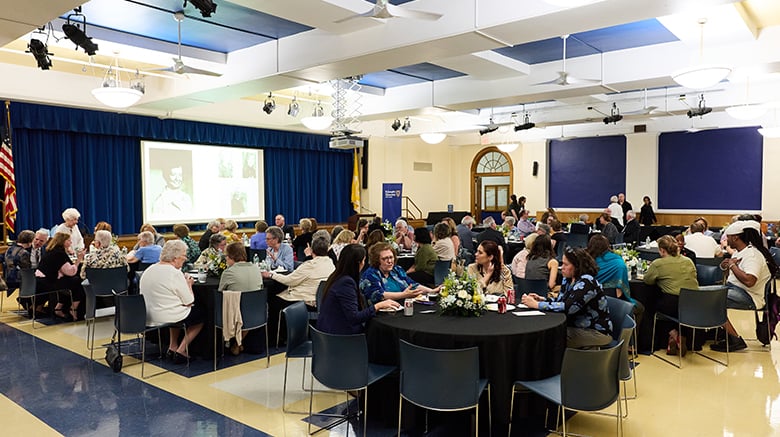
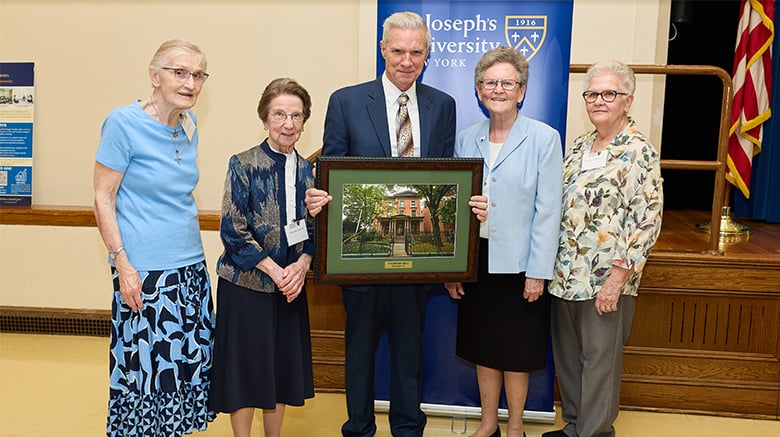
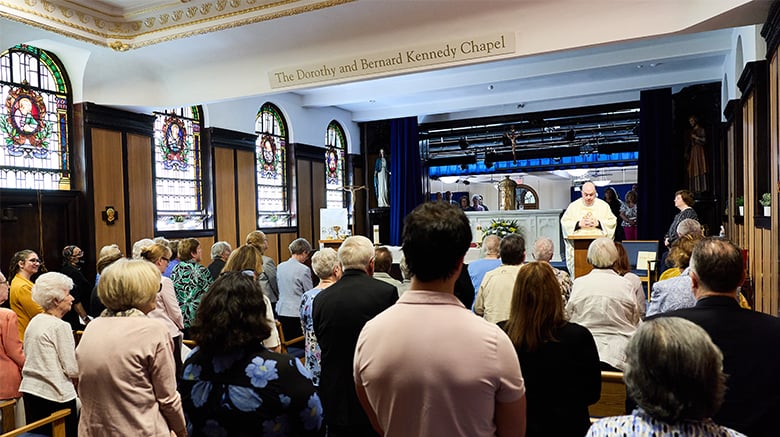
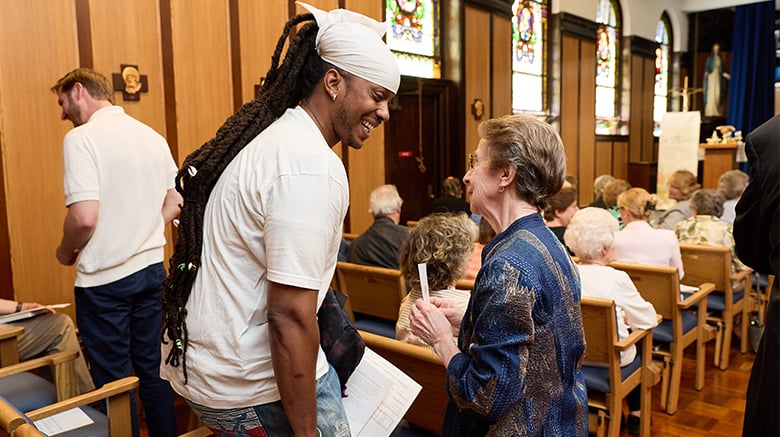
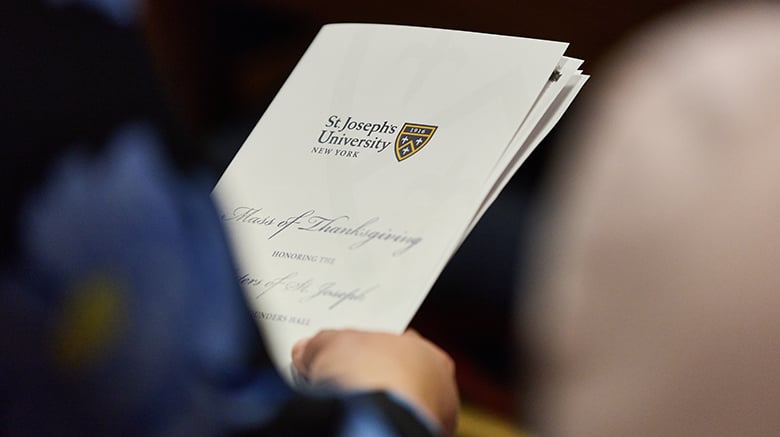
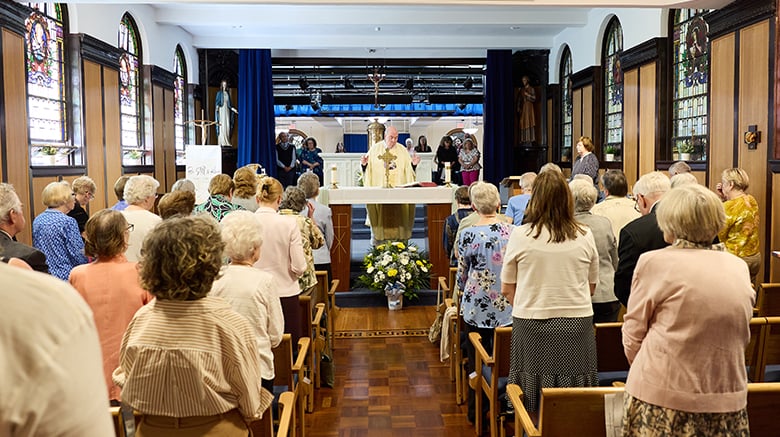
On Monday, June 8, St. Joseph’s University, New York held a special Mass of Thanksgiving honoring the Sisters of St. Joseph of Founders Hall, who will be departing the convent later this summer. The mass took place in the Brooklyn Campus’ Dorothy and Bernard Kennedy Chapel and was followed by a luncheon in the auditorium, which is also located inside Tuohy Hall.
The building, previously known as Pratt mansion, was bought by the University (then called St. Joseph’s College) in 1936 and named in honor of the institution’s founders – the Congregation of the Sisters of St. Joseph.
Although there was an air of bittersweetness to the event, which coincided with the news of the upcoming departure of the sisters from the Brooklyn convent they called home for 90 years, the main theme of the event focused on a more inspiring theme of transformational change.
A Word from Father Thomas Ahern ’85
Father Thomas Ahern was the first speaker to focus on the theme of change and transformation.
During the homily, Fr. Thomas, who graduated from St. Joseph’s in 1985, admitted that he had been thinking a lot about the Mass of Thanksgiving leading up to the day, wondering how he would address the congregation. But what came to mind, he said, was one of the many conversations he’d had over the phone with Sister Mary Florence Burns ’46, CSJ, Ph.D.
S. Mary Florence Burns ’46, who was a revered figure at the University and served as a professor of English, academic dean and vice president for academic affairs for more than 80 years, entered into eternal light on July 23, 2025 at the age of 100.
Fr. Thomas said that oftentimes during such conversations with S. Mary Florence Burns, while discussing what was happening in the Church, both at the local and global level, he would, “sometimes be lamenting all the changes we were going through – and still are going through – in the Church. And she acknowledged them, certainly…. But she had a very wise way of explaining things,” he said.
At such moments, he said she would be reassuring and say, “‘You know, Tom, we’re going through something so big we don’t see it all. It’s something that’s happening all over the world to the Church. And we really just have to trust in the Holy Spirit.’”
For Fr. Thomas, it was an important lesson that illustrated how such changes required us “to rely on the guidance of the Holy Spirit. Because what’s going on is beyond our comprehension.”
He acknowledged that many in the congregation were bound to have feelings of sadness at their departure. But he said what’s more profound is to focus on their mission – not only their “selfless dedication to their mission of education, but their actual presence here: The sisters were always very present to the students and to the staff,” Fr. Ahern said. “They were always around, supporting and attending, which I think is one of the great gifts that they were able to share with us.”
A Vital and Longstanding Legacy
Having that kind of connection to the student community has become a vital legacy for St. Joseph’s University New York. “The dedication of the sisters has rubbed off on the faculty,” Fr. Ahern observed, and noted that the lay faculty has continued that quality of presence and dedication to the students. “The sisters have left a lasting legacy here that has continued. And I think all the students would agree that the influence of the sisters has transformed them.”
It’s why he ended his homily by saying, “Let us not leave here with heavy hearts, but be grateful that we have had an opportunity to experience their communal life and their love for God and for one another. And that has transformed us.”
At the luncheon that followed the Mass of Thanksgiving, Donald R. Boomgaarden, Ph.D., president of SJNY, elaborated on the notion of transformational change, by commenting on how much change is taking place not only for the sisters, but, in many ways, for all of us.
“But I’ll tell you what hasn’t changed,” said Dr. Boomgaarden. “What hasn’t changed is transformation. It’s actually a transformation that the sisters initiated in every student that they taught.”
He continued, “It’s a transformation of a student into the individual that God meant them to be. The idea that the sisters are inculcating, aiding and assisting young people to dream the dream that God dreamt for them. That beautiful thought of transformational change was built into the mechanism of the sisters’ view of education.”
Dr. Boomgaarden also pointed out how essential this quality has been in keeping the University financially sound. He recalled how during a conversation he had with S. Mary Florence Burns about the importance of change and transformation, he remembered her saying that, “the reason the University is still here is because we were always willing to change. There are a lot of universities that are not here anymore because they refused to change.”
Such a powerful paradigm has allowed the University to maintain, “a willingness to develop and build new programs,” Dr. Boomgaarden said, “as well as a willingness to improve old programs. And a willingness to find ways to lead the students into that zone where they are really becoming the individual that God wants them to become.”
Looking Toward the Future
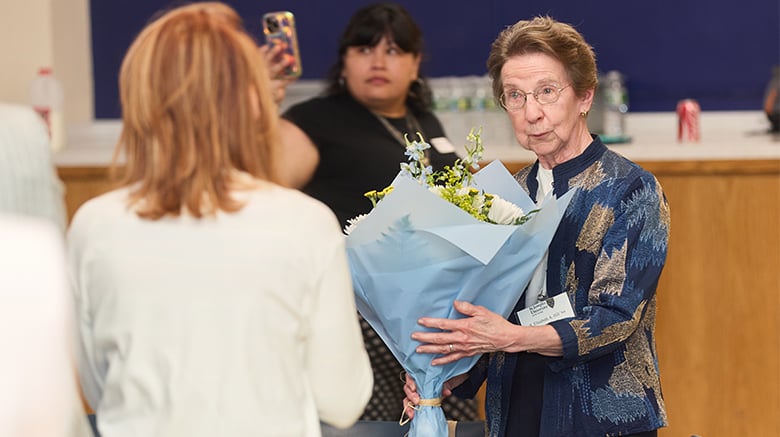
For Sister Elizabeth A. Hill, ’64, CSJ, J.D., who served as the institution’s sixth president, from 1997 to 2014, and who was the last speaker at the luncheon, transformational change could – and should – be looked at as a powerful, motivating force for good in our world today. In other words, such change should motivate us to help transform the world for the better, especially in times of hardship.
One of the ways she felt this could be achieved was for all those connected to SJNY to reflect on the essence of the mission statement of the Sisters of St. Joseph: “We live and work that all may be one,” she said.
“That’s our hope. That’s our goal. That’s our reason for being. That’s why we get up in the morning,” she said. “To try to be a human presence in the world. To be a reconciling presence. To bring people together. And in the world that we live in right now, that is so desperately needed.”
With so many divisions currently taking place in our society that need healing, S. Elizabeth A. Hill offered those in the St. Joseph’s University, New York community a powerful call to action: To heal the world, we all need to live and work to bring people together.
“Only that can be done by us,” she said. “We can’t wait for somebody else to do it. Each of us has a part in it. Each of us has a role to play. So, I urge each of you to take into your heart the spirit of the Sisters of St. Joseph.”