
Breaking New Ground
More than 100 years after its founding, sustainability remains a core component that bridges St. Joseph’s University, New York to its founders, the Sisters of St. Joseph. As the University continues to expand in new and exciting ways, its commitment to caring for its neighboring community has never wavered or been eclipsed by new projects.
In fact, sustainability efforts at St. Joseph’s have only grown stronger thanks to the work of its students, faculty and alumni, who continuously break new ground on ecological-based initiatives. In a domino effect of sorts, each new phase has unveiled another piece of the bigger picture — one of a university that fosters academic research, community and environmentalism.
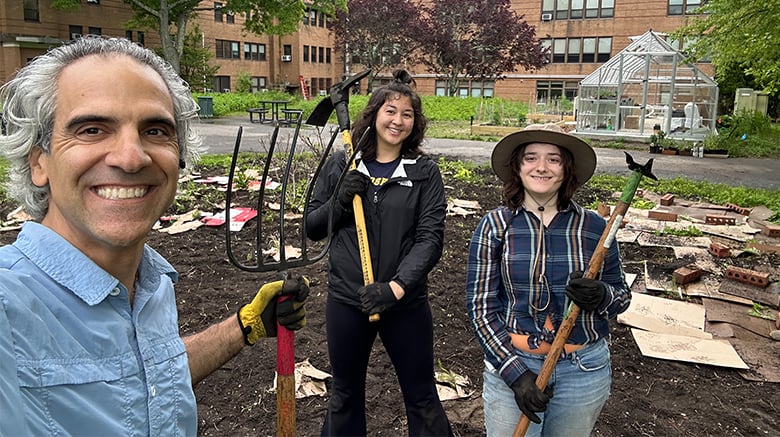
It’s an effort that began during the fall 2025 semester when the University’s Sustainability Committee and Department of Biology launched the revitalization of the Shea Garden behind O’Connor Hall. Funded through a gift from SJNY Trustee and alumna Marsilia Boyle ’69, students, faculty, staff and alumni gathered to clear out weeds and overgrown bushes from the area, replacing them with native plants donated by the Long Island Native Plants Initiative (LINPI).
A Greenhouse Effect for Growth
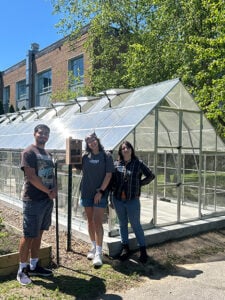
The Elyse Deublein Harney ’52 Greenhouse
The native plants provide a food source and habitat for local animals, attracting insects and local birds as they prepare to migrate for the winter season. Meanwhile, signage was placed so that those visiting the garden could learn more about the native plants and their effect on the environment.
Although located on the Long Island Campus, the project has engaged the entire University community. Hosted by the Go Green Club and Biology Department in February, Brooklyn and Long Island students united for a winter sowing event, creating small planters using repurposed bottles. Over 70 planters were made to support pollinators in the garden.
Sustainability efforts at St. Joseph’s continue to advance with the construction of its greenhouse this past spring. Made possible through the generosity of SJNY alumna, honorary doctorate recipient and 2026 Commencement speaker Elyse Deublein Harney ’52, the greenhouse has ushered in a new era for the Shea Garden. Its controlled environment will enhance plant growth all year round, helping to sustain the Shea Garden as a native perennial pollinator garden.
Student Research This Summer
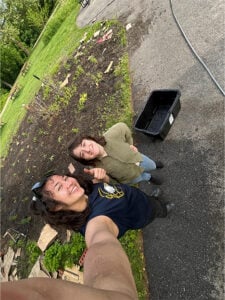
SJNY Biology students Abigail DeBiase ’27 and Norah Williams ’27
Even as students and faculty enjoy their summer break away from campus, there are those at work continuing to support the Shea Garden and the University’s sustainability efforts.
That includes Norah Williams ’27 and Abigail DeBiase ’27, two biology students who are spending their summer at SJNY entrenched in joint undergraduate research. Throughout the summer, both students have been weeding out the garden, planting native perennials and observing the native pollinators inhabiting the area.
Norah Williams ’27
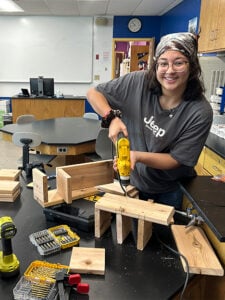
Norah Williams ’27 preparing bee hotels for the pollinator garden.
Williams, with a minor in chemistry, is currently working on her thesis involving insect pollinators. Her research is centered on creating a preliminary survey of the pollinator insects in the garden for others to build off of it and collect more data over time.
“I have been researching the impact of bee hotels and have created my own hotels as well. I have made three bee hotels and bought three ground insect hotels. The purpose of these hotels is to encourage the insects to live there and make their cavities there for their young,” Williams said.
She continued, “In addition, these hotels can also protect them from predators that can lead to a greater decrease in their population. I made three different spaces (firewood, grooved boards and bamboo bundles) in the hotel to test for my thesis to determine which space is the best for the bees.”
Abigail DeBiase ’27
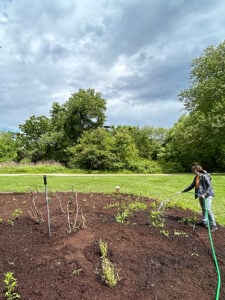
Abigail DeBiase ’27 tending to native plants in the pollinator garden.
For DeBiase, her work in the Shea Garden is far from her first rodeo. Last summer, she worked as an intern with the Sisters of St. Joseph Sustainability team. The experience provided all the training she would need in habitat restoration and garden management. Her research focuses on surveying the local bird population.
“Throughout the week at varying times, I perform a point-count survey in which I stay stationary in one place and mark down all the birds I can see and hear in the surrounding area for 10 minutes,” DeBiase said.
She further explained her research, stating, “Afterward, I plug everything into a spreadsheet that will be analyzed for information such as the most common species, the most common locations birds frequent, most common activities for local birds, etc. This will serve as the baseline for many more population surveys to come, as Dr. Rountos would like to continue this project so population trends can be observed over years of recorded data.”
The work being conducted in Shea Garden has long-term implications for the sustainability of both SJNY and Long Island. Beyond supporting local ecosystems, it reinforces the University’s longstanding bond with the Sisters of St. Joseph in their joint effort to educate and inspire.
