For the summer of 2025, 10 students were selected for the Summer Undergraduate Research Fellowships (SURF), an SJNY-funded undergraduate research program that provides stipends of $4,000 for each student recipient to work on research projects, overseen by a faculty mentor.
With an overarching goal of alleviating the economic pressures that can prohibit strong students from actively engaging in academic research opportunities, the SURF program is open to students of all disciplines. Recipients conduct their research for 10 weeks over the summer and then present at the Student Research Symposium the following spring.
Investigating Biofilms with Dr. Hanophy
On the Brooklyn campus, Olivia Lieto ’27 worked with Michael Hanophy, Ph.D., chair and professor of biology. Dr. Hanophy has studied biofilm biology for more than 15 years and has directed over 75 student research projects during his time at SJNY.
The research by Lieto concentrated on biofilms, which consist of surface-dwelling microbial communities that create EPS (extracellular polymeric substances) to form a sticky adhesive material. Biofilms possess protective properties against antibiotics and immune system responses which makes them a vital subject for scientific research in medical and environmental science.
Her research centered on two species of bacteria commonly found in the human mouth: Actinomyces viscosus and Streptococcus salivarius. “These bacteria are consistently in our mouths, playing a role in common dental plaque, like cavities,” Lieto explained. She studied how nutrient levels and other conditions influenced the bacteria’s interactions and their ability to form layers of biofilm.
A Hands-On Learning Experience
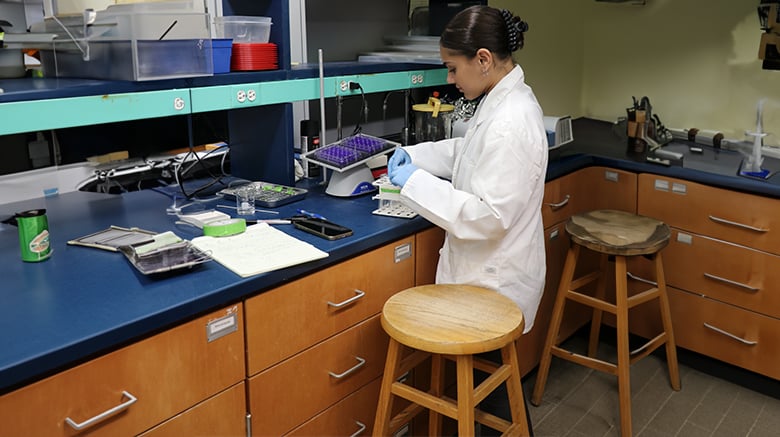
Lieto described her research process as both structured and flexible. A typical day began by observing bacteria incubated from the previous session, followed by running different techniques to measure biofilm growth. These included dyeing and rinsing cultures to measure absorbance, using microscopic imaging to examine slide samples and setting up new growth conditions for future experiments.
“Although it portrays a very similar methodology each day, every day in the lab is different and the results of our previous days reflect how we move on,” she said. For example, her team systematically decreased nutrient levels each week to observe changes in bacterial growth and interaction.
Lieto especially valued the independence that came with SURF.
“Within labs for courses we have to go by the specific program and procedures given to us for the class,” she explained. “However, with this research I have a sense of freedom in which I can create my own procedures and switch up techniques and methods in order to obtain different types of information.”
Growth Through SURF
For Lieto, the SURF fellowship has been more than just a summer project. “Being selected for the SURF program has given me the opportunity to gain a unique experience in the field of research,” she said.
She credits Dr. Hanophy’s mentorship with expanding her comfort in the lab and deepening her interest in biology.
“Working alongside Dr. Hanophy has given me the chance to learn under someone with valuable experience in the research and biology field,” she said. “He has also opened me up to his years of education and research, bringing joy to the environment through different stories and insights.”
Through SURF, Lieto discovered not only new scientific knowledge but also confidence and independence as a researcher. Her work contributes to a growing understanding of how everyday bacteria interacts in ways that can affect human health.
This story is part of OnCampus’ “SURF Recipients 2025” series, centered on students conducting research at St. Joseph’s University, New York in anticipation of the University’s 2026 Student Research Symposium. To read more from this series, click here.
